
Students at IGNOU university ask the following question: “How do I compose my IGNOU AHE project?” It is true that even those students who obtain some information, either online or offline, need help finding them thorough and decisive. This is another reason they need reliable and comprehensive information on the best way to plan for IGNOU AHE Project. If you are also among the IGNOU students who need solid information about how to compose IGNOU projects, the following tips will be handy to you:
How to Choose AHE Project Topics
Selecting the right topic is the first and most important step in your IGNOU AHE project. A good topic should match your interest and relate to environmental issues that can be observed or researched easily. Avoid choosing subjects that are too broad or require complex data collection.
Think about issues around you — waste management, air pollution, renewable energy, or people’s environmental awareness. Choose something you can connect with and explain clearly in your report.
Here are some topic ideas students often pick:
-
Impact of Plastic Waste on Local Environment
-
Awareness of Climate Change among School Students
-
Role of Youth in Tree Plantation Drives
-
Study on Water Conservation Practices in Urban Areas
-
A Comparative Study of Solar and Wind Energy Use in Villages
Once you decide the topic, write it in simple, specific terms. Keep it short, relevant, and practical for your project work.
Synopsis: Format & Example
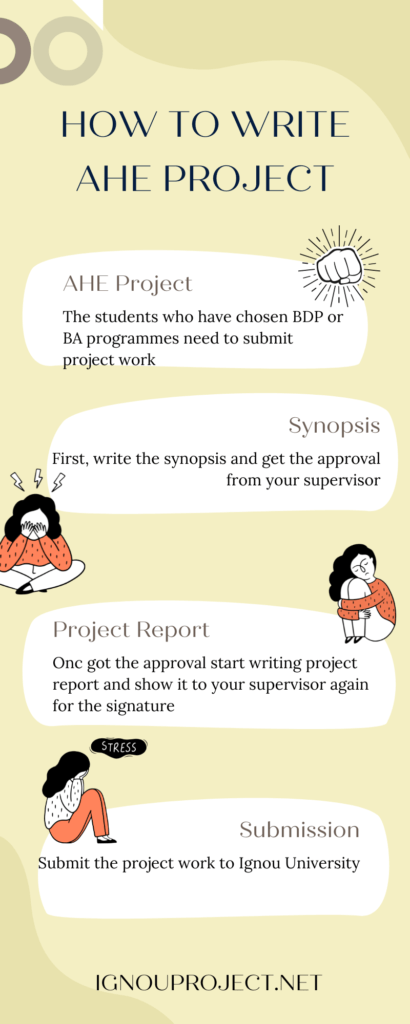
Before you start writing your full AHE project report, you must prepare a synopsis. The synopsis is a short summary of your proposed study. It helps IGNOU understand what you plan to research, why it matters, and how you will collect your data.
AHE synopsis should be 4 to 6 pages long — short, focused, and well-structured.
Your synopsis must include the following points:
-
Title of the Project – Choose a short and clear title. For example, “Awareness about Waste Segregation among Households in Patna City.”
-
Introduction – Write 1 or 2 paragraphs explaining why you chose the topic and why it is important for society or the environment.
-
Objectives of the Study – Mention 3–4 main goals. For instance:
-
To study people’s awareness about waste segregation.
-
To understand the reasons behind improper waste disposal.
-
To suggest measures for better waste management.
-
-
Research Methodology – Explain how you will collect data. Will you use a questionnaire, observation, or interview? Mention the number of participants and location.
-
Expected Outcome – Write what you expect to find or learn through your study.
-
References (if any) – Add the books, articles, or websites you used for background reading.
Sample Example of AHE Synopsis
Title: Awareness about Water Conservation Practices among School Students in Delhi
Introduction:
Water is a vital resource, yet it is often wasted due to lack of awareness. This study aims to understand how well school students are informed about water conservation and how their daily habits contribute to saving or wasting water.
Objectives:
-
To examine students’ knowledge of water-saving techniques.
-
To identify common causes of water wastage in schools.
-
To suggest awareness programs for better conservation practices.
Methodology:
The study will be based on a questionnaire survey of 50 students from three schools in Delhi. Simple random sampling will be used. Data will be analyzed using percentage methods.
Expected Outcome:
The research will show the level of awareness among students and highlight areas where awareness campaigns can improve water-saving habits.
Report: Structure & Page Limits
Once your synopsis is approved, you can begin the main AHE project report. This is your chance to present real findings in a structured and readable form.
The report must be between 40 and 60 pages, including annexures and bibliography. About 45–50 pages is ideal if each section is well-written.
Suggested Report Structure
-
Front Page
-
Title of the project
-
Student name and enrolment number
-
Programme code, study centre, and supervisor details
-
Session and submission year
-
-
Certificate of Originality
-
A short declaration signed by you and your supervisor confirming that the work is genuine.
-
-
Acknowledgement
-
Thank your supervisor and anyone who guided or supported you.
-
-
Table of Contents
-
List all chapters and sub-sections with page numbers.
-
-
Introduction
-
Introduce your topic and its importance in simple language. Explain what inspired your study.
-
-
Review of Literature
-
Summarize previous studies or reports related to your topic. It shows you understand the background.
-
-
Objectives
-
Restate your goals clearly, matching those approved in the synopsis.
-
-
Research Methodology
-
Explain your approach — how you collected data, number of participants, and tools used (questionnaire, interview, etc.).
-
-
Data Analysis and Interpretation
-
Present your findings using tables or charts, then explain them in words. Write what the numbers or responses indicate.
-
-
Findings and Suggestions
-
Highlight the main results and give realistic suggestions. For example, awareness programs, local initiatives, or policy-level steps.
-
-
Conclusion
-
End with 1–2 paragraphs summarizing your study and its importance. Mention what you learned and how it contributes to environmental awareness.
-
-
Bibliography
-
List all sources used, in this format:
Author’s Name, Title, Publisher, Year.
For websites: “Page Title,” Website Name, Accessed on Date.
-
-
Appendix
-
Attach questionnaires, charts, or other supporting materials.
-
Page and Presentation Tips
-
Keep handwriting neat and uniform.
-
Write on one side of the sheet only.
-
Number all pages correctly.
-
Avoid unnecessary images or filler text.
-
Be consistent with margins and spacing.
A well-organized report shows seriousness and helps you score higher. IGNOU examiners appreciate clarity and effort more than fancy words.
AHE COURSE DETAIL AND FEES
| Bachelor of Arts (BA) | Details |
|---|---|
| Minimum Duration | 3 Years |
| Maximum Duration | 6 Years |
| Course Fee | Rs. 6,000 |
| Minimum Age | No bar |
| Maximum Age | No bar |
| Eligibility | 10+2 or its equivalent or BPP from IGNOU |
Submission Timeline & Where to Submit
After completing your AHE project report, the next step is submission. Many students finish their work on time but lose marks or face rejection simply because they miss the deadline or send it to the wrong place. Submitting correctly is as important as writing a good report.
Submission Timeline
IGNOU accepts project submissions twice a year — once for the January session and once for the July session.
Here are the usual deadlines:
-
For January Session:
-
Synopsis submission: By April 30
-
Final project report submission: By November 30
-
-
For July Session:
-
Synopsis submission: By November 30
-
Final project report submission: By May 30
-
These dates can slightly vary depending on official notifications. Always confirm the exact deadlines from the official IGNOU website (ignou.ac.in) or by visiting your Regional Centre. It’s best to check updates every few weeks, especially close to the submission period.
If you miss the deadline, you may have to wait for the next session, so plan early and submit at least a week before the last date.
Where to Submit the AHE Project
The project report must be submitted physically to your Regional Centre not online and not at the Study Centre.
You can submit it by hand or send it through speed post to the regional office. Keep a copy of the receipt or acknowledgement for your records.
Your submission packet should include:
-
Approved Synopsis Copy (signed by your guide)
-
Certificate of Originality
-
Final Project Report (spiral-bound)
-
Proforma of Synopsis Approval
-
Appendix / Questionnaire (if applicable)
Make sure every page of your project is arranged in proper sequence and well-bound. Loose pages or missing certificates often lead to rejection or delays in evaluation.
After Submission
Once your project is received, the Regional Centre sends it for evaluation. You can check your result later on the IGNOU website under “Student Zone → Results → Project Reports.”
The evaluation may take a few months, so keep your enrolment number handy for updates. There is no viva voce for the AHE project — marks are awarded based on written work and presentation quality.
Useful Tips for a Smooth Submission
-
Double-check the spelling of your name and enrolment number.
-
Don’t staple or use plastic folders — only spiral binding is accepted.
-
Attach all documents in the correct order.
-
Keep a digital backup of your entire project before submitting.
Submitting your report with care shows professionalism and ensures a smooth evaluation process. Even a small mistake like a missing signature can cause unnecessary stress, so review everything calmly before handing it over.
Related Blog
Keep an eye on your AHE 1 Solved Project Pages
You should know the number of pages you should write if you wish to have your IGNOU AHE solved project assessed thoroughly.
Some students make it too long, while others make it too thin. You must complete your project report in between 40 to 60 pages is recommended that you complete your project work within 40-45 pages.
It’s essential to be aware that these 45 pages should be more than just a collection of material you think is worthless. Your next page is likely to be the continuation of your previous one, and your last one should give an idea about every single one for their reviews.
At IGNOU AHE project, we also offer online content analysis solutions in English and Hindi.
Your mission to learn how to compose IGNOU AHE Project will positively propel you forward.
Identify the Sequence of your Pages
Once you have completed your project, you must organize your synopsis and report according to the IGNOU guidelines. Details like your name, enrollment number, study center code, and other things must be mentioned on the front page of your project work.
- Proforma of synopsis duly signed by your supervisor
- Approved synopsis
- Certificate of originality (signed by your academic supervisor)
- Project report
- Questionnaire (if your research work is based on the primary study)
Common Mistakes Students Make in AHE Project
Even after putting in effort, many students lose marks in the AHE project because of small but avoidable errors. Knowing these mistakes early can help you submit a clean, well-prepared report that stands out.
1. Copying Content from the Internet
This is the most common and serious mistake. IGNOU evaluators easily recognise copied or AI-generated text. Avoid downloading reports or copying sample materials. Instead, use them only as a reference and write your own observations. A project written in your own words, even if simple, is always rated higher.
2. Poor Topic Selection
Some students pick topics that are too vague or not connected to the environment. For example, “Pollution” as a title is too general. Choose something that focuses on a specific issue or community — such as “Air Pollution Levels in Residential Areas of Jammu.”
Specific topics show that you understand what you want to study.
3. Missing Supervisor Approval
Every synopsis must be approved and signed by your project guide. Submitting without the supervisor’s signature makes the project invalid. Always keep one photocopy of the signed synopsis for future reference.
4. Untidy Handwriting or Poor Presentation
If you are submitting a handwritten report, make sure your writing is neat and consistent. Avoid scribbles, arrows, and overwriting. Presentation counts — clear headings, correct numbering, and simple formatting make your project easy to read and evaluate.
5. Ignoring the Page Limit
IGNOU specifies a limit of 40–60 pages. Submitting a 20-page report looks incomplete, while writing 100 pages filled with repetitive material adds no value. Stick to 45–50 pages of meaningful, focused content.
6. Late Submission
Many students finish their work but forget to check the deadline. Submitting even a day late can push your project to the next session. Always plan to submit a week before the last date. Don’t wait for reminders from IGNOU.
7. Missing Documents
Projects often get rejected because of missing enclosures. Always include:
-
Certificate of originality
-
Approved synopsis copy
-
Questionnaire or appendix (if used)
-
Signature of supervisor and student
8. Weak Conclusion
Some students end the report abruptly without summarizing their findings. A good conclusion ties everything together — what you found, what it means, and how it helps the community or environment. Keep it short but thoughtful.
Final Words
The AHE project is not just an academic task — it’s a chance to apply what you’ve learned about the environment to real life. When you write with sincerity, follow the structure, and meet the deadlines, your project automatically stands out.
A report that reflects clarity, originality, and honest effort always earns good marks at IGNOU.
Frequently Asked Questions (FAQS)
1. What is the AHE Project in IGNOU?
AHE is an Environmental Studies project required for IGNOU’s BDP and other undergraduate programs. It helps students understand real environmental issues by conducting a small research or field-based study.
2. How many pages should the AHE report have?
The final report should ideally be 40 to 60 pages long. Keeping it within this range ensures that your work looks focused and complete.
3. Can I type the project or should it be handwritten?
Both options are accepted by IGNOU. Typed reports look more professional, but if you’re handwriting, make sure the writing is neat and readable.
4. What documents should be attached with the project?
You must attach the following:
- Certificate of originality
- Supervisor’s approval
- Copy of approved synopsis
- Questionnaire (if any)
5. Where should I submit the AHE project?
You can submit it at your IGNOU Regional Centre either in person or by post. Always keep a photocopy of your report and postal receipt for safety.
6. How long does IGNOU take to evaluate the project?
Usually, evaluation takes 6–8 weeks after submission. The result appears along with your term-end marks on the IGNOU website.