
IGNOU Project Help
Synopsis Writing & Submission Guidance
Support for MBA, MCOM, MAPC, MCA, MARD, MTTM and all IGNOU courses — from topic selection to final submission.
The Right Guidance Makes All the Difference
Most project rejections happen not from poor effort but from not knowing exactly what IGNOU expects. We fix that.
IGNOU Project Help
Guidance from topic selection to final submission. We help with synopsis, project structure, referencing, and formatting so your work follows IGNOU expectations.

IGNOU Solved Assignments
If assignments are piling up, we provide solved assignments in the correct IGNOU format. No messy answers, no random content. Just clean, easy to understand solutions.

PhD Thesis Support
If you are doing PhD research, we help with topic finalization, research planning, writing, and final submission. We guide you in a way that matches academic standards and avoids common mistakes.
Handwritten Assignments
If you do not have time to write, we can provide handwritten assignments as per IGNOU guidelines. This is useful for students who want a clean, neat, properly formatted submission.
Courses We Cover
All Major IGNOU Programmes
We guide students across every course that requires project submission. Can't find yours? Message us — we confirm within the hour.
How It Works
Four Steps to a Submitted Project
A clear process so you always know what happens next.
Share your course details
Tell us your programme, course code, session, and where you are stuck right now.
Get topic & synopsis support
We suggest the right topic and write a synopsis that follows IGNOU's exact format for your course.
Complete the project report
We guide you chapter by chapter — or write it fully — with correct structure, referencing, and formatting.
Submit successfully
We review the final project before submission and help you with any corrections your supervisor requests.
Complete IGNOU Project Guide
Everything You Need to Know About IGNOU Projects
What Is an IGNOU Project?
An IGNOU project is a mandatory academic requirement in most postgraduate, diploma, and some undergraduate programmes of the Indira Gandhi National Open University. It is more than just an assignment — it is an independent research work that tests your ability to apply what you have studied to a real-world problem.
Whether you are enrolled in MBA, MCOM, MA Psychology, MCA, MTTM, or any other programme that requires project work, the IGNOU project follows a structured process that includes a synopsis, a research methodology, data collection, analysis, and a final project report.
IGNOU Project Guidelines: What You Need to Know
IGNOU publishes official project guidelines for each programme separately. Before starting your IGNOU project, read your programme-specific guidelines carefully because the format, word count, number of chapters, and submission address can differ from course to course.
- Eligibility: You must complete a minimum number of credits or core courses before registering for project work.
- Project Guide: Most programmes require you to work under a supervisor who meets IGNOU’s prescribed qualifications.
- Originality: IGNOU evaluates projects for plagiarism. Your work must be original and properly referenced.
- Submission Format: Projects must include a cover page, certificate, acknowledgement, table of contents, chapters, bibliography, and annexures.
The IGNOU Synopsis: Your First Critical Step
Before you write the project report, you must prepare and submit a synopsis. The IGNOU synopsis is a proposal that tells the university what you plan to research, why it matters, and how you will go about it. A well-written synopsis typically includes the project title, background and rationale, objectives, research methodology, a chapter outline, and a preliminary bibliography.
The synopsis is usually 10 to 15 pages long. Once your supervisor approves it, a copy is sent to IGNOU. Only after receiving approval can you formally begin writing the full project report.
How to Write an IGNOU Project Report
Once your synopsis is approved, the actual project report writing begins. The report is typically 10,000 to 15,000 words — roughly 80 to 100 pages — and contains the following chapters:
- Chapter 1 – Introduction: Background, problem statement, objectives, scope, and limitations.
- Chapter 2 – Review of Literature: Structured review of existing research related to your topic.
- Chapter 3 – Research Methodology: How you collected data — surveys, interviews, secondary sources, or case studies.
- Chapter 4 – Data Analysis: Findings presented using tables, charts, or narrative analysis addressing your stated objectives.
- Chapter 5 – Conclusions: Summary of findings, implications, and recommendations for further research.
- Bibliography and Annexures: All cited sources and supporting documents.
IGNOU Project Submission: How and When
IGNOU runs two submission cycles annually. For the June exam session, the deadline is typically around 31st March to 30th April. For the December exam session, the deadline is around 30th September to 31st October. Always verify the current dates on the IGNOU official website.
For most programmes, IGNOU accepts online project submission through the student portal at onlineproject.ignou.ac.in. Students must upload a scanned PDF of the project along with the approved synopsis proforma, project guide’s bio-data, and a signed originality certificate.
Common Reasons for IGNOU Project Rejection
- Mismatch between the approved synopsis and the final report
- Missing or incorrect formatting — absent certificates, wrong margins, no supervisor signature
- Plagiarism or submitting a readymade project that others have already used
- Incomplete submission — missing annexures or unsigned forms
- Beginning the report before the synopsis is formally approved
IGNOU Project Formatting Guidelines
Formatting errors are one of the most common — and most avoidable — reasons an IGNOU project gets sent back for correction. While exact specifications can vary slightly by programme, most IGNOU project reports follow a consistent structural standard that evaluators expect to see.
- Font and spacing: Times New Roman, 12pt for body text, with 1.5 line spacing is the widely accepted standard across programmes.
- Margins: Typically 1.5 inches on the left (for binding) and 1 inch on the other three sides.
- Page numbering: Roman numerals for preliminary pages (certificate, acknowledgement, table of contents) and Arabic numerals for the main chapters.
- Cover page: Must include the project title, your name, enrolment number, programme code, study centre, regional centre, and the year of submission.
- Certificate page: A signed declaration from your supervisor confirming the project is your original work and was carried out under their guidance.
- Binding: Hard copy submissions are usually expected to be spiral-bound or hardbound, depending on your programme’s specific instruction.
Always cross-check these details against your own programme’s project guide, since IGNOU occasionally updates formatting requirements between sessions.
Choosing the Right IGNOU Project Topic
Topic selection sets the direction for your entire project, so it deserves real thought rather than a quick guess. A strong IGNOU project topic is specific enough to research thoroughly within the page limit, relevant to your specialisation, and realistic in terms of the data you can actually access.For example, an MBA student should avoid an overly broad topic like “Marketing Strategies in India” and instead narrow it to something like “Impact of Digital Marketing on Customer Retention in the Indian Retail Banking Sector.” A focused topic is easier to research, easier to defend, and far more likely to be approved by your supervisor on the first attempt.If you are unsure where to begin, look at recent industry trends in your field, gaps in existing literature, or a problem you have direct access to data on — through your workplace, your region, or a sector you already understand.
Working With Your Project Supervisor
Your project guide plays a central role at every stage — from approving your synopsis to signing off on the final report. Building a clear, professional line of communication with your supervisor from the start makes the entire process smoother.Share your topic ideas early, ask for feedback on your synopsis before finalising it, and keep your guide updated as you progress through each chapter. Supervisors are far more likely to approve work quickly when they have been involved throughout, rather than seeing the completed report for the first time at the end.
Tips to Avoid Plagiarism in Your IGNOU Project
IGNOU takes originality seriously, and plagiarised content is one of the fastest ways to get a project rejected outright. Plagiarism is not limited to copying word-for-word — closely paraphrasing another source without proper citation, or reusing data and analysis from someone else’s project, also counts.
-
- Cite every source you reference, including books, journal articles, and websites, using a consistent referencing style throughout.
- Write your analysis chapters in your own words, even when summarising someone else’s findings.
- Avoid downloading “ready-made” or “sample” projects from unreliable sources and submitting them with minor edits — these are frequently flagged.
- Run your final draft through a plagiarism checker before submission to catch any unintentional overlap.
IGNOU Project FAQs by Stage
Most student queries fall into a few predictable stages of the project journey. Knowing what to expect at each stage helps you plan your timeline realistically.
Before starting: Confirm your eligibility, identify a suitable supervisor, and check your programme’s specific project code and guidelines.
During synopsis preparation: Finalise your topic, define clear objectives, and outline your research methodology before submitting for approval.
During report writing: Follow the chapter structure precisely, maintain consistent formatting, and stay in regular contact with your supervisor.
Before submission: Proofread thoroughly, verify all required documents and signatures are in place, and confirm whether your programme requires online upload, a hard copy, or both.
Blogs
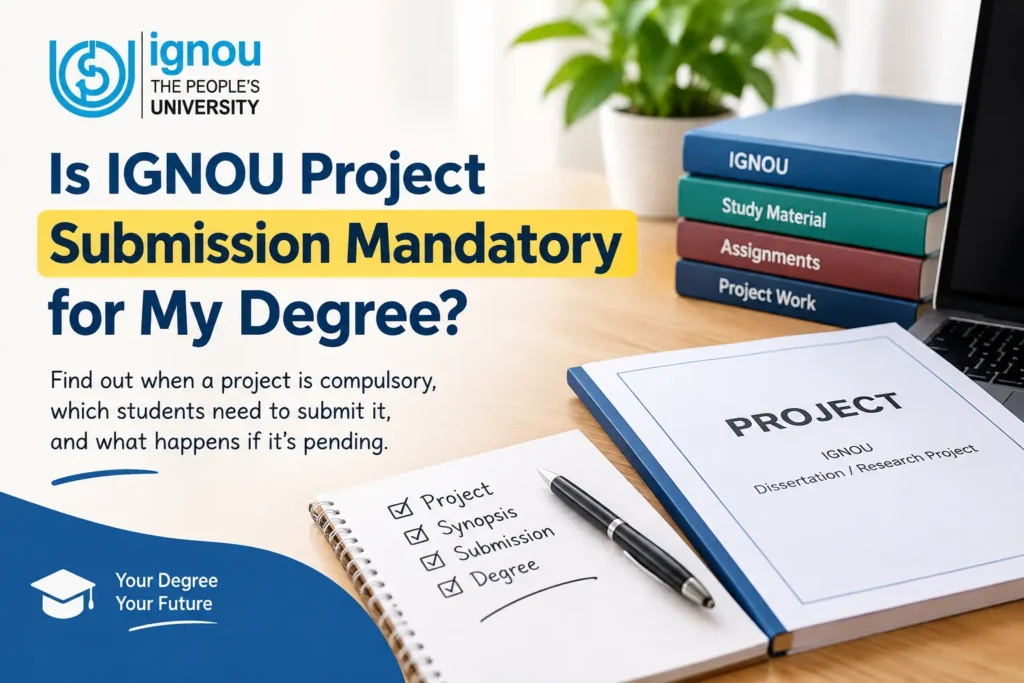
Is IGNOU Project Submission Mandatory for My Degree?
Yes, IGNOU project submission is mandatory if your programme includes a compulsory project or dissertation course. Students whose programme does not include a project do not need to submit one for their degree. The exact requirement depends on your IGNOU programme, course structure, and applicable project guidelines. Before starting your project, check your programme structure […]

What Exactly Is Required in an IGNOU MCom Project Synopsis?
A good IGNOU MCom project synopsis is much more than a formality. It is the first document that explains your research idea and helps the university understand what you plan to study. If your synopsis is clear, relevant, and follows the IGNOU guidelines, the chances of approval become much higher. Many MCom students feel confused […]

IGNOU MCOM Project Format Explained With Chapter Wise Structure
Many MCOM students lose marks not because their topic is weak, but because their project format is wrong. This is a hard truth. IGNOU does not only evaluate what you write. It also evaluates how you present it. Chapter order, flow, clarity, and structure matter more than students expect. Most students start writing randomly. Some […]
Customer Reviews


Frequently Asked Questions
What is an IGNOU project?
An IGNOU project is a mandatory academic requirement in many postgraduate, diploma, and selected undergraduate programmes. It involves preparing a synopsis, conducting research, collecting and analyzing data, and submitting a final project report that is evaluated separately from theory examinations.
How do I write an IGNOU project synopsis?
An IGNOU synopsis should include the project title, introduction, objectives, research methodology, chapter plan, and bibliography. It serves as a blueprint for the final project and must be approved before starting the complete report.
What are the IGNOU project submission deadlines?
IGNOU generally announces separate project submission deadlines for the June and December examination sessions. Students should always verify the latest dates through official IGNOU notifications to avoid missing submission deadlines.
Why do IGNOU projects get rejected?
Projects may be rejected due to plagiarism, improper formatting, mismatch between synopsis and final report, incomplete documentation, missing signatures, or failure to follow university guidelines.
Which IGNOU courses require a project?
Several IGNOU programmes require project work, including MBA, MCOM, MAPC, MCA, MARD, MTTM, MPS, PGDDM, MLIS, DNHE, MAEDU, and many other postgraduate and diploma courses.
Ready to Start Your IGNOU Project?
Send us your course details and we will guide you step by step — from topic selection to final submission.